01The premise
From container to embedding
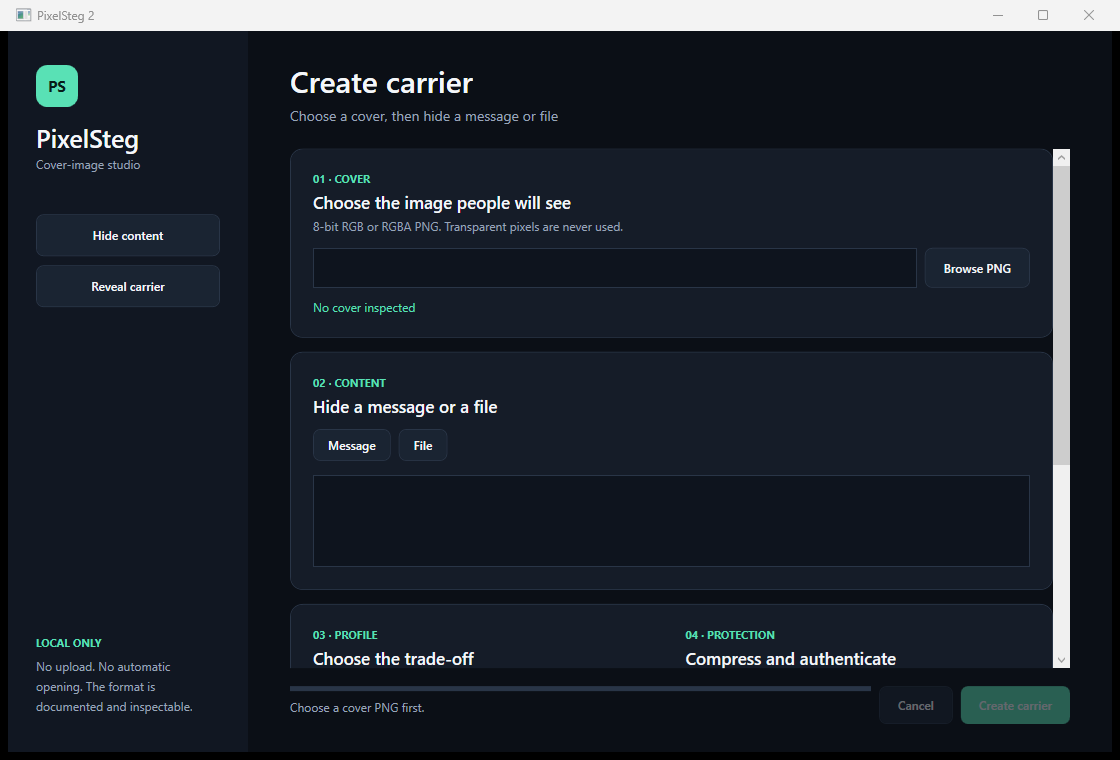
The new version does not write payload as a visible pixel matrix. It takes an existing non-interlaced 8-bit RGB or RGBA PNG and changes selected low color bits. Only fully opaque pixels are used.
Before writing, PixelSteg calculates actual capacity. Afterwards it measures MSE, PSNR and global SSIM. These metrics compare the technical image change; they prove neither human invisibility nor resistance to steganalysis.
02Inside the system
Messages and files inside existing PNGs
Balanced
One low bit per RGB channel in image order is the default for unchanged PNG carriers.
1 BIT / CHANNELDense
Two bits per channel roughly double capacity while allowing larger color changes.
2 BITS / CHANNELAdaptive
Textured 8×8 blocks are prioritized before embedding continues in a controlled order.
TEXTURE PRIORITYResilient
Adaptive placement plus Hamming(12,8) can correct one flipped bit in each codeword.
HAMMING(12,8)Locator and inspection
A fixed and deliberately detectable locator describes the profile and package before a password is requested.
PUBLIC FORMATContent and protection
UTF-8 messages or up to 64 files can optionally use Brotli and AES-256-GCM.
BROTLI / AES-GCM03Concrete workflow
Where it is useful
PixelSteg supports file-format experiments, reproducible steganography demonstrations and local handoffs where a PNG is deliberately selected as carrier. Capacity preview, profile comparison and quality values keep the decision reviewable.
pixelsteg embed-file cover.png carrier.png notes.txt map.pdf --profile balanced
pixelsteg inspect carrier.png
pixelsteg extract carrier.png recovered
From input to evidence
Inspect
The cover is checked for format, pixel count and usable capacity.
Protect
Bundle, compression and optional encryption are prepared.
Embed
The selected profile distributes data through low RGB bits.
Measure
Capacity, MSE, PSNR, SSIM and integrity remain visible.
Design boundaries
The boundary is the lossless image
- Public, detectable format; no promise against steganalysis or image editing
- Resize, crop, color adjustment, palette conversion and recompression can destroy payload
- Resilient is not general protection against cropping, scaling or JPEG compression
- Encryption does not hide the PixelSteg locator or prove who created the carrier
- Recovered files remain untrusted content
05RC facts
PixelSteg · RC facts
- Release candidate
- 2.0.0-rc.1
- Carrier
- non-interlaced 8-bit RGB/RGBA PNG
- Profiles
- Balanced, Dense, Adaptive, Resilient
- Content
- UTF-8 message or up to 64 files
- Optional
- Brotli, AES-256-GCM, PBKDF2-HMAC-SHA-256 with 600,000 iterations
- Metrics
- capacity, MSE, PSNR, global SSIM
- Quality assurance
- 63 automated tests in the RC state
- Data path
- fully local
The carrier remains a lossless PNG while technical changes and protection limits stay measurable and open.