01The premise
The starting point
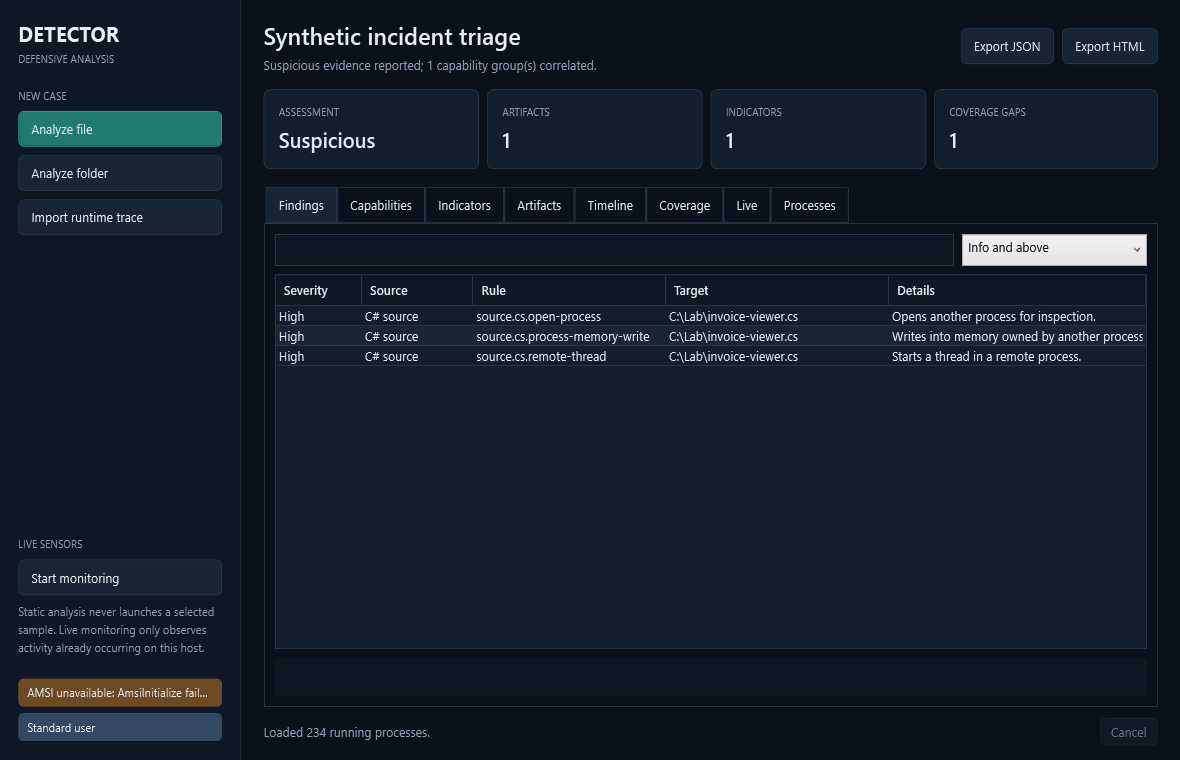
Detector is designed for initial defensive triage on Windows. It profiles PE and managed .NET artifacts, examines C# and PowerShell, and records the results in a stable case model. Related rules become readable capabilities with confidence, sources and supporting evidence.
One boundary applies from the start: Detector does not launch the selected file. Runtime behavior must be imported from an isolated environment or come from optional read-only sensors observing activity already occurring on the local Windows host.
02Inside the system
Static and observed evidence in one case
PE and .NET
Hashes, type, signature state, sections, imports, assembly, target framework and P/Invoke are read without loading the assembly.
STATIC / METADATAC# and PowerShell
Explicit rules cover process access, memory manipulation, dynamic loading, persistence, credentials and download-and-run chains.
LEXICAL RULESIndicators and capabilities
URLs, domains, IP addresses, commands, registry and file paths remain as evidence and are correlated transparently.
EVIDENCE / CONFIDENCEImported runtime evidence
Normalized JSONL and common Sysmon events produce a UTC timeline without executing the sample on the analyst host.
JSONL / SYSMONOptional local sensors
AMSI, read-only process memory, and ETW or polling observe activity already occurring on the host.
AMSI / ETW / MEMORYCoverage
Missing providers, permissions, event losses and unreadable processes remain visible gaps.
COMPLETE / PARTIAL03Concrete workflow
A practical workflow
An unknown artifact and its Sysmon events are placed in an isolated analysis folder. Detector builds a case. Findings and correlated capabilities are reviewed first; the timeline then shows which static leads were observed. Coverage gets the final review: what ran, what was unavailable and where data is missing.
detector analyze .\triage --report-json .\case.json --report-html .\case.html
detector import-trace .\events.jsonl --report-json .\runtime-case.json
From input to evidence
Collect
Static artifacts and imported events enter the same case.
Separate
Findings, indicators, timeline and coverage remain distinguishable.
Correlate
Related rules become capabilities with sources and confidence.
Review
JSON and HTML support analysis and technical handoff.
Design boundaries
What the tool does not replace
- Does not execute unknown samples and replaces neither EDR nor incident response
- Not antivirus, a disassembler or a detonation service
- Cannot certify completeness or absence of malware
- Short-lived processes, protected targets and incomplete logs remain blind spots
- An API name proves neither reachability nor malicious intent
05RC facts
Detector · RC facts
- Release candidate
- 2.0.0-rc.1
- Analyzes
- PE, .NET, C# and PowerShell
- Runtime evidence
- normalized JSONL and Sysmon events
- Optional local signals
- AMSI, read-only process memory, ETW/polling
- Case views
- Assessment, Findings, Capabilities, Indicators, Artifacts, Timeline, Coverage
- Quality assurance
- 141 automated tests in the RC state
- Safety boundary
- no execution of selected samples
The tool is strongest where it keeps uncertainty and missing coverage visible.